Spis treści
- Which hydraulic fitting is right for my application?
- What are hydraulic fittings and what is their function?
- What types of hydraulic fittings are available?
- Understanding thread types: metric, BSPP, BSPT and NPT
- Cutting ring fitting or DKO system?
- You should take these selection criteria into account
- Common mistakes when selecting a hydraulic fitting
- Which standards are relevant?
- How STAUFF Connect helps with selection
- FAQs
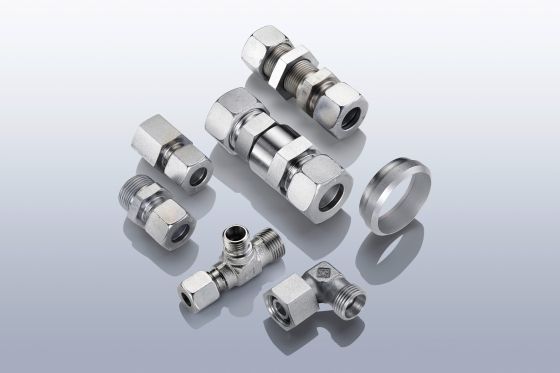
Which hydraulic fitting is right for my application?
The correct hydraulic fitting depends on several factors. Key factors include operating pressure, fluid, temperature range, pipe dimensions, thread type, sealing principle and the environmental conditions of the application. A hydraulic fitting should never be selected on the basis of a single parameter alone. Only the interplay of all technical requirements ensures that the connection functions reliably, safely and in accordance with standards over the long term.
Anyone wishing to select a hydraulic fitting should therefore proceed step by step. The first step is to define the application’s requirements. Next, the pressure range, pipe dimensions, thread type and the appropriate sealing principle must be considered. Equally important is the question of which standards are used in the system and what stresses the connection is subjected to during operation.
The better these criteria are understood, the easier it is to select the right solution and the lower the risk of leaks, failures or unplanned downtime.
Checklist: Selecting the right hydraulic fitting
Before making your selection, check:
Operating pressure and possible pressure peaks
Fluid used
Temperature range
Pipe diameter and pipe type
Type of thread available
Desired sealing principle
Space available for installation
Vibrations and dynamic loads
Relevant norms and standards
Once these points are known, it is usually possible to identify the appropriate hydraulic fitting with certainty.
What are hydraulic fittings and what is their function?
Hydraulic fittings connect the individual components of a hydraulic system to one another. They ensure that lines, pipes, hoses, valves or power units are securely connected and that hydraulic fluids can be transported under pressure.
However, their role extends far beyond mere connection. A hydraulic fitting must remain permanently leak-tight, withstand pressure loads and function reliably even under difficult operating conditions. Even the smallest leaks can lead to loss of performance, increased wear or failures.
For this reason, hydraulic fittings are among the safety-critical components of a system. Correct selection and installation contribute significantly to the operational safety and service life of the entire system.

What types of hydraulic fittings are available?
Hydraulic fittings are available in numerous designs. The appropriate design depends on the route of the pipework and the requirements of the application.
Straight Unions are used when pipes need to be connected in a straight line. They are among the most common solutions in plant and mechanical engineering.
Equal Elbows are used where changes in direction are required or where space constraints need to be taken into account. They help to ensure that pipe routing is compact and free from stress.
Equal Tees allow a flow rate to be distributed across several pipes. Equal Cross connectors are used when several pipes need to be joined or distributed within a system.
In addition, there are numerous specialised solutions such as pipe connectors, Thread Reducers, adaptors and Weld Fittings. These components enable the adaptation of different connection types and help to construct complex hydraulic systems in accordance with standards.
Understanding thread types: metric, BSPP, BSPT and NPT
Choosing the correct thread is one of the most important steps when selecting a hydraulic fitting. Although threads may appear similar at first glance, they can differ significantly in terms of geometry, sealing and standardisation.
Metric threads are frequently used in European hydraulic applications. They are based on millimetre measurements and are specified in numerous standards.
For imperial threads, BSPP, BSPT and NPT are the most common.
BSPP stands for Whitworth Parallel Pipe Thread (BSPP). Sealing is not achieved by the thread itself, but by an additional sealing surface or an O-ring.
BSPT is a tapered pipe thread. The sealing effect is achieved through the conical shape of the thread.
NPT is particularly common in North America. This is also a tapered thread, but its geometry differs from that of BSPT.
A common source of error is confusing similar thread types. As even minor discrepancies can lead to leaks, threads should always be identified precisely. Markings on the components, thread gauges, technical drawings or manufacturer’s specifications can help with this.
Cutting ring fitting or DKO system?
With hydraulic fittings, it is not only the thread that plays an important role. The sealing principle used is equally crucial.
The Cutting Ring Connector is one of the most commonly used connection systems for hydraulic pipes. When the connector is tightened, the Cutting Ring cuts into the pipe surface in a controlled manner. This creates a positive-lock, high-strength connection.
A DKO connector operates with a 24° Taper and an additional O-ring. Sealing is achieved via the O-ring rather than the threaded connection. This principle ensures a reliable seal even under demanding operating conditions.
O-rings are generally used wherever a defined and reproducible seal is required. The seal material and design must always be matched to the medium, temperature and pressure.
Which system is more suitable depends on the specific application. Important factors include pressure levels, installation requirements, ease of maintenance and the specifications of the relevant standards.
You should take these selection criteria into account
Hydraulic fittings are often selected on the basis of just a few characteristics. In practice, however, all operating conditions should be taken into account.
Operating pressure is one of the most important factors. In addition to the normal working pressure, potential pressure peaks must also be taken into account. Under-sizing can significantly compromise operational safety.
Equally important is the medium used. Different hydraulic fluids place different demands on Seal Materials and seals.
The temperature range also influences the selection. Extreme temperatures can alter the properties of seals and Seal Materials, thereby compromising the leak-tightness of a connection.
Pipe diameters and wall thicknesses must also be taken into account. The Connector must fit the pipework used exactly in order to achieve the required load-bearing capacity.
Installation conditions play a particularly important role in confined spaces. Equal Elbows or special adaptors can make installation significantly easier in such situations.
Last but not least, vibrations and oscillations should be taken into account. Mobile machinery, Construction Machinery or industrial plant often generate dynamic loads that require a correspondingly robust connection technology.
Common mistakes when selecting a hydraulic fitting
Many problems in hydraulic systems can be traced back to errors in the selection or design of the connection technology.
A common mistake is to consider only the thread size. Two fittings may appear similar externally yet comply with different standards or sealing principles.
Equally problematic is the combination of incompatible systems. If different thread or sealing systems are connected to one another, the risk of leaks increases significantly.
Operating conditions are also frequently underestimated. Connectors that are not designed for the intended pressure or temperature range may wear out prematurely or fail.
Another common mistake is neglecting the installation requirements. Even the best hydraulic fitting cannot fulfil its function if it is installed incorrectly.
The consequences range from creeping leaks and increased maintenance costs to unplanned plant downtime.
Which standards are relevant?
Standards provide the basis for safety, interchangeability and the reliable design of hydraulic systems.
The DIN 2353 and ISO 8434-1 standards are particularly relevant. Both define requirements for metric Tube Fittings and their areas of application.
Standardised systems offer considerable advantages for designers and purchasers. Components from different manufacturers can be compared more easily and interchanged within the limits set by the standards.
Furthermore, standards facilitate the design of machinery and plant used internationally. They establish clear technical specifications and reduce the risk of incorrect application.
Therefore, the standard should always be taken into account when selecting a hydraulic fitting. In many cases, it is more important than the thread size alone.
How STAUFF Connect helps with selection
Anyone selecting hydraulic fittings benefits from connection systems that are as consistent and standards-compliant as possible. This is precisely where STAUFF Connect comes in.
The range includes, amongst other things, 24° cutting ring fittings, 24° taper fittings with O-ring, 24° Weld Cones with O-ring, and 37° flared tube fittings. This enables a wide variety of requirements to be met within a coordinated system.
For users, the system-based approach is particularly relevant. Rather than selecting individual components in isolation, suitable solutions for different connection types, pipework and installation scenarios can be combined.
The focus should be on the technical solution. Interested users will find detailed information on designs, dimensions and available versions in the respective product categories.
Additional aspects such as corrosion protection, surface properties and standard-compliant system solutions can also play an important role in demanding applications.
Discover the STAUFF range
You can find all products in the STAUFF Connect series in our online shop.

FAQs
What is a hydraulic fitting?
A hydraulic fitting is a connecting element that joins pipes, hoses or components within a hydraulic system. Its function is to transport hydraulic fluids under pressure in a safe and permanently leak-proof manner.
Which hydraulic fitting is the right one?
The correct hydraulic fitting depends on the operating pressure, medium, temperature, pipe dimensions, thread type and sealing principle. Selecting a fitting based solely on thread size is not sufficient.
What is the difference between a cutting ring fitting and a DKO fitting?
In a Cutting Ring Connector, the connection is formed by the controlled cutting of the Cutting Ring into the pipe. A DKO Connector, on the other hand, seals via a sealing cone with an additional O-ring.
What types of thread are used in hydraulic systems?
The most common thread types include metric threads, BSPP, BSPT and NPT. They differ in terms of geometry, standardisation and sealing principle.
How do I identify the size of a hydraulic fitting?
The size is determined by the thread diameter, pitch and the relevant standard. Ideally, it is identified unambiguously using thread gauges and technical data sheets.
Which standard applies to metric hydraulic fittings?
In the field of metric Tube Fittings, DIN 2353 and ISO 8434-1 play a particularly important role. They define key requirements for design and area of application.
Can I combine different fitting systems?
As a general rule, only compatible systems should be combined. Differences in threads, sealing principles or standards can lead to leaks and malfunctions.
What role does operating pressure play in the selection process?
Operating pressure is one of the most important selection criteria. A hydraulic fitting must be able to withstand both the working pressure and any possible pressure peaks on a long-term basis.

Newsletter Sign-up
Sign up now and never miss another post!